Ranking a business in a religious tourism hub is not the same as ranking one in an ordinary commercial city. When people search for accommodation, transport, or retail near the Haram, they compare options in seconds, often on mobile, often in more than one language. That is exactly why demand for professional SEO services in Makkah has grown so sharply through 2026, as local operators fight for a slice of an audience measured in millions of annual visitors.
This guide breaks down what actually moves the needle for search visibility in a high-competition, multilingual market. You will get a practical framework, a comparison table, and answers to the questions business owners ask most. Whether you run a hotel, a travel agency, or a retail outlet, the fundamentals below will help you turn search traffic into real bookings and walk-in customers.
Why SEO Services in Makkah Demand a Different Playbook
Makkah is a seasonal, faith-driven economy. Search volume spikes around Hajj and Ramadan, then settles for the Umrah season that runs most of the year. A campaign built for a steady-demand city will miss those peaks entirely.
Successful strategies here plan content and promotions months ahead of each season. They also account for pilgrims who search in Arabic, English, Urdu, Malay, and more. Ignoring language intent leaves easy rankings on the table.
Competition adds another layer. Global travel platforms and large hotel chains pour heavy budgets into the same keywords local operators need. Winning against them requires sharper targeting, not deeper pockets, and that is precisely where a focused local strategy pays off.
The Multilingual Intent Layer
A visitor typing “hotels near Haram” wants a different result than one typing the same phrase in Arabic. Smart optimization maps each query to a dedicated, well-structured page instead of forcing one page to serve everyone.
- Separate landing pages for each core language and service.
- Clear hreflang signals so Google shows the right version.
- Locally relevant schema for hotels, tours, and events.
- Reviews surfaced in the visitor’s own language where possible.
Local SEO Foundations That Actually Convert
Technical polish means little without local trust signals. Google’s own guide to ranking systems stresses relevance, distance, and prominence for local results, and all three are earned, not bought.
Start with an accurate Google Business Profile. Then build consistency everywhere your name, address, and phone number appear. Even small mismatches confuse search engines and cost rankings.
- Claim and fully complete your Google Business Profile.
- Fix name, address, and phone consistency across all citations.
- Collect and respond to genuine customer reviews weekly.
- Publish season-specific posts before demand peaks.
- Earn links from reputable travel and local directories.
Comparing Common Optimization Priorities
| Priority | Effort | Time to Impact | Best For |
|---|---|---|---|
| Google Business Profile | Low | 2 to 6 weeks | Walk-in and map traffic |
| Multilingual pages | High | 2 to 4 months | International pilgrims |
| Review generation | Medium | Ongoing | Trust and conversion |
| Seasonal content | Medium | Before each peak | Hajj and Umrah demand |
How Cross-City Expertise Strengthens Local Campaigns
Agencies that operate across regions bring tested playbooks rather than guesswork. Experience won optimizing competitive Pakistani markets, for example, transfers directly to Gulf campaigns because the underlying search behavior rhymes.
Providers delivering SEO services in Multan face equally crowded local niches, from textiles to hospitality. The tactics that break through there, tight keyword mapping and disciplined citation building, apply cleanly in Makkah too.
What travels between markets is the discipline, not the templates. A team used to squeezing results from limited budgets learns to prioritize ruthlessly. It fixes the highest-impact issues first and ignores the shiny distractions that drain time without moving rankings.
That mindset matters in Makkah, where seasonal windows are short and unforgiving. There is no room to waste weeks on low-value work when a Hajj peak is approaching. Cross-city veterans know how to move fast and focus on what converts.
What to Look for in a Provider
Do not judge an agency on promises. Judge it on process. Ask how it researches keywords, how it measures conversions, and how it reports progress each month.
- Transparent monthly reporting tied to bookings, not just rankings.
- A documented content calendar aligned to your season.
- Clear ownership of your accounts and data.
- References or case studies you can verify.
When you evaluate candidates, weigh whether they field an experienced local team who understand your market rather than a rotating list of freelancers with no continuity.
Measuring Results the Right Way
Rankings feel satisfying, but revenue pays the bills. Tie every campaign to concrete outcomes such as booking form submissions, phone calls, and direction requests from your map listing.
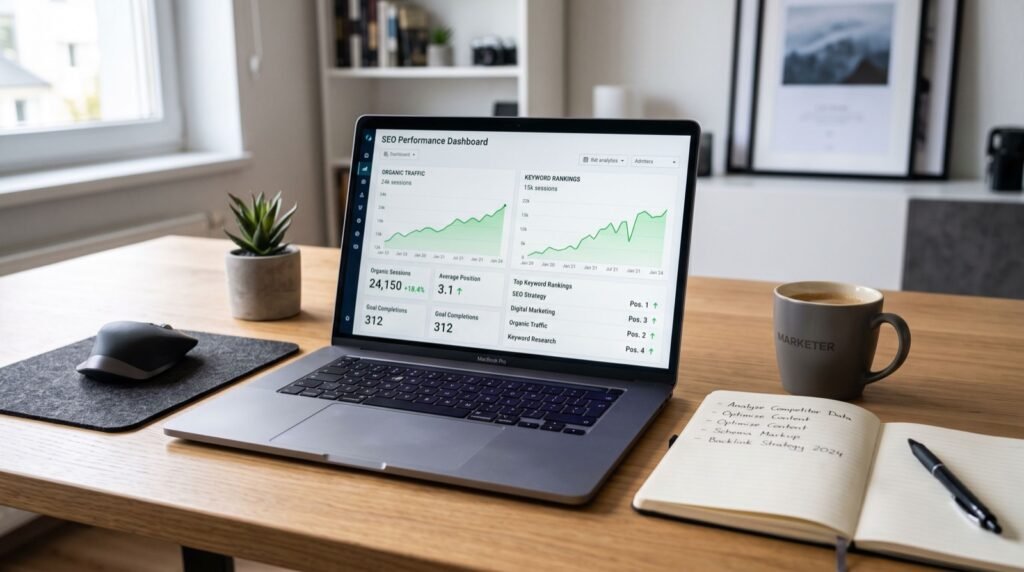
Set a simple dashboard that tracks these numbers month over month. According to Moz’s Beginner’s Guide to SEO, aligning metrics with business goals is what separates lasting programs from vanity projects.
Attribution deserves special care in a seasonal market. A booking made during Umrah season may have started with a search weeks earlier. Track the full journey, not just the final click, so you credit the channels that truly filled your calendar.
Compare each season against the same period last year rather than the previous month. Year-over-year comparison strips out the natural rise and fall of pilgrimage demand and shows whether your strategy is genuinely improving.
Practical Tip From the Field
One overlooked lever is speed. Pilgrims often browse on older phones with patchy connections. Compressing images and trimming scripts can lift both rankings and conversions at the same time, a rare two-for-one win.
Another quiet advantage is answering practical pilgrim questions directly on your pages. Distance to the Haram, prayer-time considerations, and transport options all draw searches. A hotel that addresses these openly earns trust before a visitor ever makes contact, and trust is what turns a click into a confirmed booking.
Frequently Asked Questions
How long do SEO services in Makkah take to show results?
Most businesses see early map and local gains within four to eight weeks. Competitive organic keywords in multiple languages typically take three to six months of steady work.
Do I need separate pages for each language?
Yes. Dedicated pages with correct hreflang tags let Google serve the right version to each pilgrim, which improves both rankings and user experience across markets.
Is local SEO worth it for small hotels?
Absolutely. A well-optimized Google Business Profile plus consistent reviews often delivers the strongest return for small operators competing near the Haram.
Can one agency handle both Saudi and Pakistani markets?
Yes, and cross-market experience is an advantage. Tactics proven in competitive Pakistani cities transfer well to Gulf campaigns when adapted to local language intent.
Conclusion
Winning search in a religious tourism capital takes seasonal planning, genuine multilingual pages, and relentless local trust building. Get those right and the traffic follows. If you are ready to grow bookings this season, invest in proven SEO services in Makkah and pair them with disciplined measurement. Start with your Google Business Profile today, then build the rest around it.